


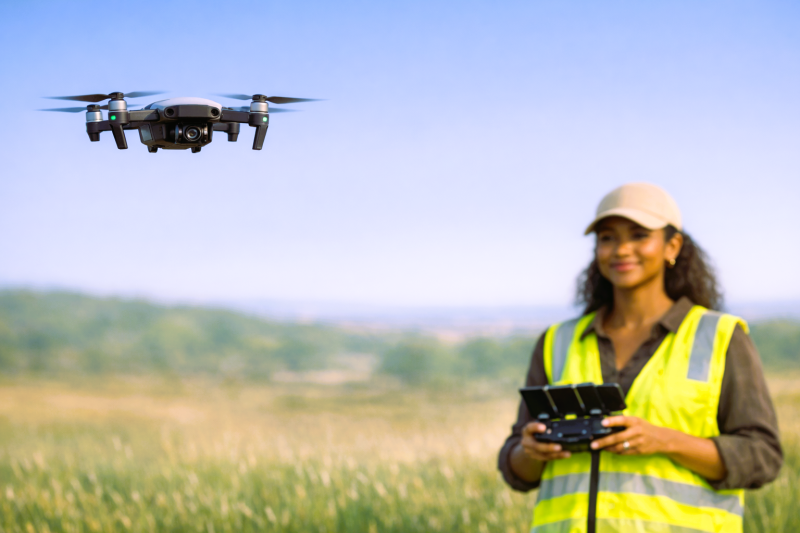
2025 FAA remote pilot certification figures indicate sustained growth in women’s participation and broader geographic distribution across the United States.
Women have contributed to aviation innovation for more than a century. From early aircraft design to today’s rapidly expanding uncrewed aviation ecosystem. As drones become increasingly integrated into commercial, public safety, and STEM applications, understanding who is entering the remote pilot workforce helps illuminate how the industry is evolving.
In FAA terminology, a remote pilot refers to a certified commercial drone pilot—an individual authorized to operate drones for professional, commercial, public safety, research, and educational use.
Each year, Women and Drones© reviews FAA data to track growth trends and highlight where participation is increasing. The newly released Year-End 2025 numbers show continued expansion in the remote pilot community and meaningful gains among women earning certification.
According to an FAA report, there was a 15.1% year-over-year increase in the total number of remote pilots from 2024 to 2025. The report states that there were 492,311 FAA-certified remote pilots at the end of 2025, up from 427,598 in 2024. This growth reflects the expanding use of drones across industries such as infrastructure inspection, emergency response, agriculture, environmental monitoring, and media production.
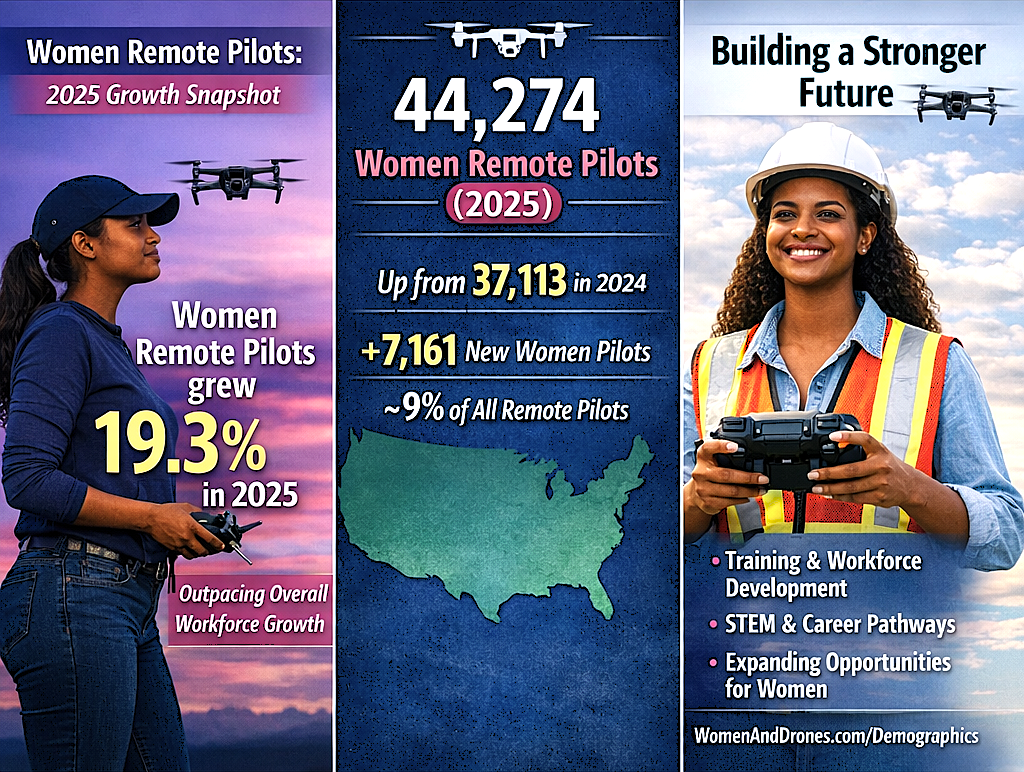
Women Remote Pilots: A 19.3% Increase Over 2024
Women Remote Pilots also saw strong growth:
- 44,274 Women Remote Pilots (YE 2025)
- Up from 37,113 in 2024
- A year-over-year increase of 7,161, or 19.3%
Women now account for about 9% of all certified remote pilots and represent a broad cross-section of ages and backgrounds. Based on 2025 FAA data, the average age of a U.S. woman commercial drone pilot is approximately 39 years old, with the largest participation occurring between ages 25 and 44. This reflects both early-career entrants discovering drone technology through STEM pathways and mid-career professionals integrating drones into existing fields such as public safety, media, agriculture, and infrastructure inspection.
This increase reflects expanding awareness, broader access to training, and the impact of community-driven efforts that encourage more women to explore aviation and uncrewed systems.
Where Growth Accelerated: State-Level Increases
With full 2024 and 2025 state-level data now available, two complementary views help illustrate where participation among women remote pilots is expanding most rapidly: percent growth and total numeric growth. Looking at both provides a clearer picture of how states with smaller pilot populations can show large proportional gains, while larger states add substantial numbers even with modest percentage increases.
Top 10 States Growth by Percent of Women Remote Pilots
(Among states with ≥100 women remote pilots in 2024)
These states posted the strongest proportional gains year over year.
| Rank | State | Numeric Increase | Percent Increase |
|---|---|---|---|
| 1 | South Dakota | +42 | 27.3% |
| 2 | Indiana | +173 | 26.6% |
| 3 | Wisconsin | +154 | 25.1% |
| 4 | Alabama | +103 | 25.0% |
| 5 | Louisiana | +96 | 24.6% |
| 6 | Tennessee | +162 | 25.7% |
| 7 | Colorado | +270 | 20.2% |
| 8 | Washington | +213 | 19.0% |
| 9 | Florida | +602 | 19.9% |
| 10 | California | +665 | 18.0% |
Percent growth highlights momentum: where training access, awareness, and industry adoption are accelerating most quickly.
Top 10 States by Total Numeric Growth of Women Remote Pilots
These states added the largest number of women remote pilots between 2024 and 2025—a measure that highlights where the biggest absolute gains occurred.
| Rank | State | Numeric Increase | Percent Increase |
|---|---|---|---|
| 1 | California | +665 | 18.0% |
| 2 | Florida | +602 | 19.9% |
| 3 | Texas | +596 | 18.4% |
| 4 | North Carolina | +310 | 20.5% |
| 5 | Colorado | +270 | 20.2% |
| 6 | Washington | +213 | 19.0% |
| 7 | New York | +229 | 18.9% |
| 8 | Ohio | +226 | 21.4% |
| 9 | Michigan | +217 | 24.4% |
| 10 | Virginia | +195 | 16.7% |
Numeric growth highlights scale: where the largest numbers of women are entering the workforce.
Together, these two views show a dynamic and expanding landscape:
- Smaller states such as South Dakota and Louisiana are seeing rapid proportional growth.
- Large states such as California, Florida, and Texas continue to anchor the national workforce by adding the highest numbers of new women remote pilots.
- Mid-sized states including Colorado, Washington, North Carolina, and Michigan show strong gains on both lists, signaling broadening participation across regions.
Why These Trends Matter
The drone industry is expanding rapidly, and the workforce behind it is evolving just as quickly. Tracking year-over-year changes helps:
- Identify where training and workforce development are accelerating
- Understand which regions are emerging as hubs for drone operations
- Highlight opportunities to broaden participation across all demographics
- Support educators, employers, and policymakers in planning for future needs
The data also reinforces the importance of creating pathways that welcome new talent into aviation — from youth STEM programs to professional upskilling.
Looking Ahead
As drones continue to integrate into everyday operations, the need for a skilled and diverse Remote Pilot workforce will only grow. Women and Drones will continue to track these trends and share insights that help the industry understand where progress is happening and where opportunities are emerging.
The full 2025 demographic breakdown, including age-group distributions, multi-year trends, and state-level details, is now available on the Women and Drones© website.
Explore the full demographic insights: https://womenanddrones.com/demographics/