
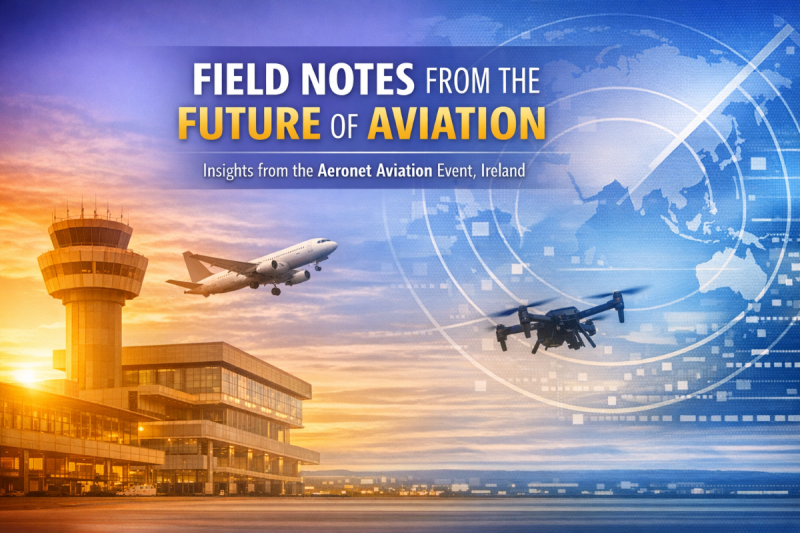
Reflections Inspired by the Aeronet Aviation Event, Ireland.
There are conferences where people gather to exchange updates, and then there are gatherings that reveal something deeper—a shift in how an entire industry understands itself. Aeronet, held just north of Dublin, was the latter. It wasn’t simply a meeting of airport leaders, aerospace engineers, and digital innovators. It was a glimpse into how aviation is quietly reinventing its foundations.
Inside the CityNorth Conference Centre, the conversations moved far beyond aircraft models or regulatory cycles. What stood out immediately was the collaboration across the many intersections of Ireland’s aviation community; airport operations, airfield management, aerospace manufacturing, digital infrastructure, satellite-enabled services, safety leadership, and emerging UAV and mobility technologies. These groups weren’t operating in silos; they were actively working through shared challenges and opportunities together.
Where Aviation Is Quietly Blending Into Innovation
Aeronet made one thing unmistakably clear: the boundaries between aviation, aerospace, and connected technologies are dissolving. The sector is evolving into a system-of-systems, where physical infrastructure and digital intelligence are inseparable. Discussions centered on materials, automation, data flows, operational architectures, and the practical realities of keeping the skies safe while enabling innovation.
This wasn’t a visionary event in the abstract sense. It was grounded, operational, and refreshingly pragmatic, and that’s precisely why it mattered. The future of aviation is being built in the details: in the workflows, the data standards, the safety frameworks, and the collaborative relationships forming across disciplines.

A Workforce That Reflects What’s Next
One of the most striking aspects of Aeronet was the breadth of expertise represented. The future aviation workforce spans:
- Airport and airfield operations leaders
- Aerospace engineers and MRO specialists
- Digital transformation and AI teams
- UAV and advanced mobility developers
- Safety, compliance, and risk professionals
- Supply chain and logistics strategists
- Regulators, policymakers, and investors
- Academic researchers and R&D innovators
This wide-ranging mix signals a sector becoming more interdisciplinary, collaborative, and innovation-driven. Aviation is no longer just about aircraft and runways. It’s about systems thinking, data fluency, and cross-domain problem-solving.
Conversations That Mattered
Among the many valuable discussions, I especially appreciated the thoughtful exchanges with John Condron and Jeremy “Jam” Hartley. Their perspectives on operational realities, emerging technologies, and the evolving needs of the aviation ecosystem added depth to the day’s themes and reinforced the importance of cross-functional dialogue.
Aeronet as a Signal, Not a Summary
Events like Aeronet are more than conferences; they are indicators of where the industry is heading. They reveal the places and spaces where aviation is blending with innovation, where traditional boundaries are dissolving, and where the next era of aviation is being quietly prototyped.
The future will not be defined by a single breakthrough. It will be defined by the convergence of human, digital, operational, material, and spatial transformation.
With Gratitude
My sincere thanks to Ian Kiely, Drone Space, Ireland, for the invitation to attend and for his leadership in fostering collaboration across the Irish aviation community.
And a special thank-you to Susan James, Premier Publishing & Events Ltd, for her warm hospitality.