


How American manufacturers are reshaping the future of uncrewed aviation.
This article provides an overview of the companies designing and manufacturing drones and uncrewed aircraft in the United States. It is not intended to be an exhaustive directory as the U.S. uncrewed aircraft market is dynamic and rapidly evolving. While we have attempted to provide a comprehensive view, it is possible that emerging companies or niche manufacturers may not be included here.
For years, the global drone market has been dominated by foreign manufacturers, especially in the consumer and prosumer categories. But as the United States shifts toward secure supply chains, National Defense Authorization Act (NDAA) compliance, and domestic manufacturing, a new generation of U.S. made drone and uncrewed aircraft companies is emerging. These companies are reshaping the future of aviation, national security, and the workforce.
Understanding NDAA Compliance, Blue UAS, and Green UAS
As agencies, enterprises, and investors evaluate U.S. made drones, two terms appear frequently and are often misunderstood: NDAA compliance and the Blue UAS list. Although they are related, they are not interchangeable. Understanding the distinction between them is essential for making informed procurement, policy, and investment decisions.
NDAA Compliance (National Defense Authorization Act)
NDAA Section 848 restricts the Department of Defense (DoD) from using certain foreign-made drone components, particularly those from China. A drone is NDAA compliant if it uses secure, approved hardware and avoids prohibited components. NDAA compliance is a legal requirement, not a list.
Blue UAS (Blue Uncrewed Aircraft Systems)
The Blue UAS program, managed by the Defense Innovation Unit (DIU), is a DoD-approved list of drones that have passed cybersecurity vetting, supply chain validation, interoperability checks, and NDAA compliance verification. All Blue UAS drones are NDAA compliant, but not all NDAA compliant drones are Blue UAS. Blue UAS is essentially a “pre-approved for federal use” pathway.
Green UAS (Green Uncrewed Aircraft Systems)
The Green UAS program, developed by the Association for Uncrewed Vehicle Systems International (AUVSI), provides a cybersecurity and supply-chain vetting pathway for drones that are not intended for DoD use. Green UAS certification is designed for state, local, commercial, and critical infrastructure operators who require a trusted platform but do not need the full rigor of Blue UAS approval. Green UAS bridges the gap between NDAA compliance and DoD-level certification, offering a scalable, industry-driven alternative for non-federal users.
Near-Term Operational Challenges in the U.S. Drone Market
As federal, state, and local agencies work to modernize their fleets and align with evolving national security expectations, the U.S. drone market is undergoing a period of rapid transition. Demand for domestically manufactured, NDAA compliant systems continues to rise, yet the supporting industrial base is still developing the capacity, consistency, and clarity needed to meet that demand.
The limited number of U.S. based manufacturers capable of producing at scale remains a central constraint, contributing to higher price points and creating gaps in product availability across key mission profiles. These constraints are further compounded by long lead times that complicate procurement planning for organizations that rely on predictable replacement cycles or rapid deployment capabilities.
At the same time, many public safety agencies, enterprise users, and state and local government operators face persistent confusion about which systems are truly NDAA-compliant, a challenge made worse by inconsistent terminology used across agencies, vendors, and integrators. Many have expressed the need for clearer, more consistent guidance as they transition away from foreign-made fleets and work to align with evolving federal expectations.
These near-term issues, while operational in nature, sit atop a deeper set of structural challenges that will shape the long-term competitiveness and resilience of the U.S. uncrewed aircraft ecosystem.
Long-Term Structural Challenges Shaping the U.S. Drone Ecosystem
Beyond the day-to-day procurement hurdles, the U.S. drone ecosystem faces broader systemic challenges that require coordinated policy, investment, and industry alignment. The absence of standardized testing and certification frameworks for U.S.-made drones remains a foundational gap, limiting both operator confidence and the ability to compare systems on equal terms. Investor hesitancy toward domestic drone startups further slows innovation, making it difficult for emerging companies to scale or compete with well-funded foreign manufacturers.
Fragmented state-level procurement rules add another layer of complexity, creating inconsistent pathways for agencies seeking to adopt compliant systems. At the same time, limited training pipelines and workforce development programs constrain the talent needed to support growth across manufacturing, operations, and maintenance. These issues are compounded by the lack of a unified national strategy for scaling U.S. drone production and the need for stronger public–private collaboration to accelerate research and development.
Finally, agencies continue to face the risk of unintentionally purchasing drones marketed as “assembled in the U.S.” that still rely heavily on foreign components, a vulnerability that underscores the need for clearer standards, transparency, and oversight as the domestic market evolves.
Consumer & Prosumer Drones: A Critical Gap in the U.S. Manufacturing Landscape
While the United States is rapidly expanding its capabilities across defense, public safety, enterprise, and specialized uncrewed aircraft systems, the consumer and prosumer segment remains the most underdeveloped portion of the domestic industrial base. Earlier in this article, we noted that “the global drone market has been dominated by foreign manufacturers, especially in the consumer and prosumer categories,” and nowhere is that dominance more visible than in the sub-$5,000 market.
This gap is not simply a matter of product availability. It reflects deeper structural challenges in cost, supply-chain maturity, and component sourcing that continue to shape the trajectory of U.S. drone manufacturing. As of 2026, the United States does not produce a true mass-market consumer drone. The lightweight, foldable quadcopters used for travel, recreation, and hobby photography are manufactured almost entirely overseas, where vertically integrated supply chains for motors, ESCs, gimbals, camera modules, and batteries enable price points U.S. manufacturers cannot match.
In contrast, American companies have concentrated their efforts in the professional and enterprise tiers, where security, reliability, and mission-specific performance outweigh cost considerations. This has pushed domestic manufacturers into the prosumer space, but even here, price points remain well above what most consumers would consider accessible. The result is a market where U.S. made aircraft exist, but primarily as higher-end tools for industrial inspection, cinematography, and specialized operations rather than as broadly available consumer products.
Compounding this divide are the realities of U.S. production. Unlike consumer drones, which are stocked in retail channels and ship within days, domestically manufactured prosumer systems are typically built to order, delivered with four- to twelve-week lead times, and sold through direct sales teams often with required training or onboarding. These characteristics reinforce the gap between consumer expectations and the operational realities of U.S. professional-grade manufacturing.
The absence of U.S. made consumer drones has broader implications. It affects STEM education, where early training relies on foreign-made platforms; workforce development, as future pilots learn on non-U.S. systems; innovation pipelines, which often begin in the consumer market; and public agency training, where low-cost NDAA compliant options remain limited. This gap is not merely a commercial issue; it is a strategic one.
There are early signs of movement, including DoD interest in small U.S.-made quadcopters, state-level restrictions on foreign-made drones, and increased venture investment in autonomy. Several startups are exploring sub-$5,000 NDAA-compliant platforms, though none have reached mass production. For now, the consumer and prosumer segment stands as the clearest reminder that the U.S. uncrewed aircraft ecosystem, while rapidly advancing, is still evolving toward full-spectrum capability.
Category Overview: The U.S. Uncrewed Aircraft Ecosystem
To help readers understand the depth of the U.S. industrial base, the following sections group companies by mission type. These categories reveal a wide-ranging, rapidly expanding ecosystem that spans defense, public safety, agriculture, industrial automation, cargo, and future propulsion. Each company includes its state and ownership status (public or private), which is especially relevant for readers following the investment landscape.
Defense & Tactical Uncrewed Aircraft Systems (UAS)
Defense and tactical UAS form one of the most mature and strategically important segments of the U.S. ecosystem. These aircraft support intelligence, surveillance, reconnaissance, and secure operations across the Department of Defense and allied nations. They must meet rigorous cybersecurity and supply chain standards, making domestic manufacturing essential. The U.S. leads globally in this category, with platforms ranging from hand-launched aircraft to large, long-endurance systems. Market leaders within this sub-sector include:
AeroVironment — VA/CA (Public): Puma, Raven, Wasp, Switchblade
Ascent AeroSystems — MA (Private): Spirit, NX30
BRINC — WA (Private): Lemur 2
General Atomics Aeronautical Systems — CA (Private): MQ9 Reaper, Gray Eagle
Inspired Flight — MT (Private): IF800 Tomcat, IF1200A
RapidFlight — VA (Private): Modular UAS
Skydio — CA (Private): X2D, X10D
Teal Drones (Red Cat Holdings) — UT (Public via parent): Teal 2
Vantage Robotics — CA (Private): Vesper
Public Safety Uncrewed Aircraft Systems (UAS)
Public safety is one of the fastest-growing segments of the U.S. drone market. Fire departments, law enforcement agencies, and emergency managers increasingly rely on drones for real-time situational awareness, thermal imaging, overwatch, and search and rescue operations. As agencies transition away from foreign-made systems, U.S.-manufactured drones are becoming essential tools for community safety and crisis response. Market leaders within this sub-sector include:
BRINC — WA (Private): Lemur 2
Skydio — CA (Private): X10, X2E
Freefly Systems — WA (Private): Astro
Inspired Flight — MT (Private): IF800 Tomcat
Vantage Robotics — CA (Private): Vesper
xCraft — ID (Private): Matrix series
Watts Innovations — MD (Private): Prism series
Industrial & Enterprise Uncrewed Aircraft Systems (UAS)
Industrial and enterprise drones support critical infrastructure, utilities, construction, energy, and cinematography. These aircraft carry specialized sensors, integrate with enterprise workflows, and often operate in complex environments. U.S.-made systems are increasingly preferred for their security, reliability, and integration flexibility. Market leaders within this sub-sector include:
Freefly Systems — WA (Private): Astro, Alta X
Inspired Flight — MT (Private): IF800, IF1200A
Watts Innovations — MD (Private): Prism, Prism Sky
xCraft — ID (Private): Matrix
WingXpand — MO (Private): Expandable fixed wing
Harris Aerial — FL (Private): Carrier H6/H8
Apellix — FL (Private): WorkerBee (painting, cleaning)
American Robotics — FL (Public via parent: Ondas Holdings): Scout System (drone in a box)
WISPR Systems — MS (Private): Ranger series
Agricultural Uncrewed Aircraft Systems (UAS)
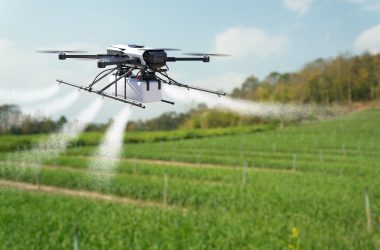
Agricultural drones are transforming crop spraying, field monitoring, and precision agriculture. While the global market is dominated by foreign manufacturers, the U.S. is rapidly building domestic capacity in both spraying and mapping systems. These platforms support food security, reduce chemical drift, and enable more efficient farm operations.
Spraying UAS
Guardian Agriculture — MA (Private): Autonomous eVTOL sprayer
Hylio — TX (Private): AG series
Harris Aerial — FL (Private): Carrier series with spray kits
Pyka — CA (Private): Pelican Spray
Mapping UAS
Freefly Systems — WA (Private): Astro
Inspired Flight — MT (Private): IF800/IF1200A
WingXpand — MO (Private): Fixed wing mapping
AgEagle Aerial Systems — KS (Public): eBee series (U.S.-manufactured models)
Heavy Lift Cargo & Logistics Uncrewed Aircraft Systems (UAS)
Heavy-lift cargo UAS refers to uncrewed aircraft capable of carrying substantial payloads — often 100 lbs. to several hundred pounds — for logistics, humanitarian aid, commercial delivery, and remote area resupply. These aircraft bridge the gap between small drones and crewed cargo aircraft, offering a new class of autonomous logistics capability. Market leaders within this sub-sector include:
Elroy Air — CA (Private): Chaparral
Sabrewing Aircraft — CA (Private): Rhaegal
Pyka — CA (Private): Pelican Cargo
General Atomics Aeronautical Systems — CA (Private): MQ9 variants with cargo capability
Future Propulsion & Long Endurance Uncrewed Aircraft Systems (UAS)
This category includes innovators pushing the boundaries of what uncrewed aircraft can do from hydrogen-electric propulsion to solar-powered perpetual flight. These companies represent the future workforce, future investment opportunities, and the next generation of sustainable aviation technologies. Key market leaders in this sub-sector include:
Hydroplane — CA (Private): Hydrogen electric propulsion
Skydweller Aero — FL/U.S. operations (Private): Solar electric perpetual flight
Kraus Hamdani Aerospace — CA (Private): K1000ULE ultra long endurance
Electra.aero — VA (Private): Hybrid electric STOL
Pyka — CA (Private): Electric autonomous aircraft
Investment Landscape: Public vs. Private Ownership
While the U.S. uncrewed aircraft sector is expanding rapidly, the vast majority of manufacturers are privately held. Only a small number are publicly traded or owned by public parent companies. This dynamic reflects a market still in its growth and consolidation phase, where innovation is largely driven by private capital, venture investment, and strategic partnerships rather than public markets.
Investor interest continues to grow, with new capital entering the sector from both traditional aerospace investors and adjacent industries. This momentum signals a market entering a new phase of maturity.
The Road Forward for U.S. Made Drones
The United States is rapidly rebuilding a secure, resilient, and innovative uncrewed aircraft industrial base but the work is far from complete. The companies highlighted in this article represent the foundation of a sector that is expanding in capability, capacity, and strategic importance.
To fully realize U.S. leadership, the nation must close the consumer and prosumer gap, strengthen domestic component manufacturing, and establish consistent standards that give operators confidence in the systems they deploy. A unified national strategy — supported by public-private collaboration, workforce development, and sustained investment will be essential to scaling production and accelerating innovation.
The momentum is real, and the next generation of U.S. manufacturers is already emerging. With coordinated action, the United States can build a full-spectrum uncrewed aircraft ecosystem that strengthens national security, fuels economic growth, and secures America’s leadership in the future of aviation.