


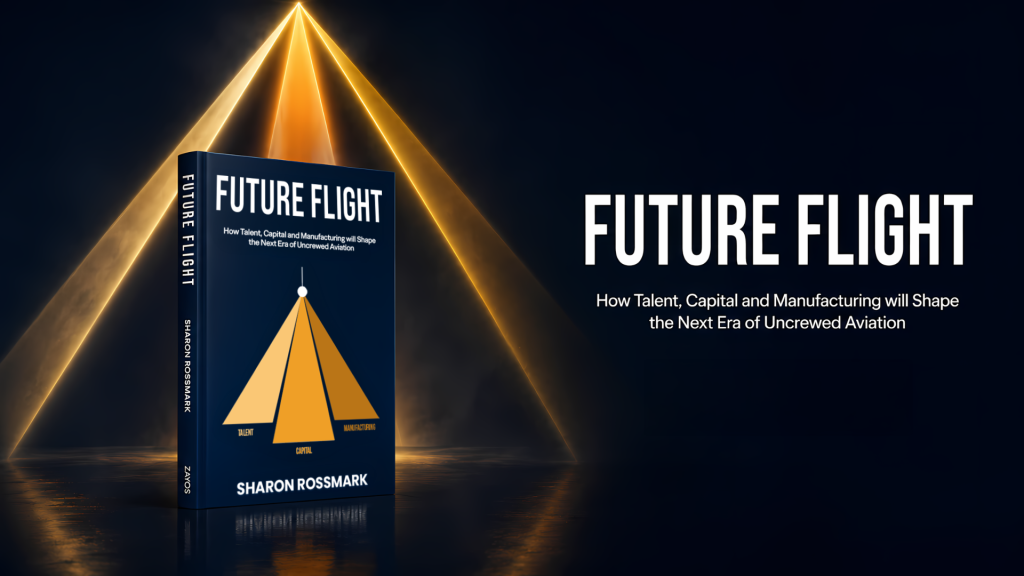
Uncrewed aircraft have spent more than two decades proving themselves across agriculture, infrastructure inspection, logistics, public safety, and national defense. The hardware works. The use cases are real. What has not kept pace, argues industry strategist Sharon Rossmark in her new book Future Flight, is everything required to turn that proven technology into durable American leadership.
Three Gaps, One Argument
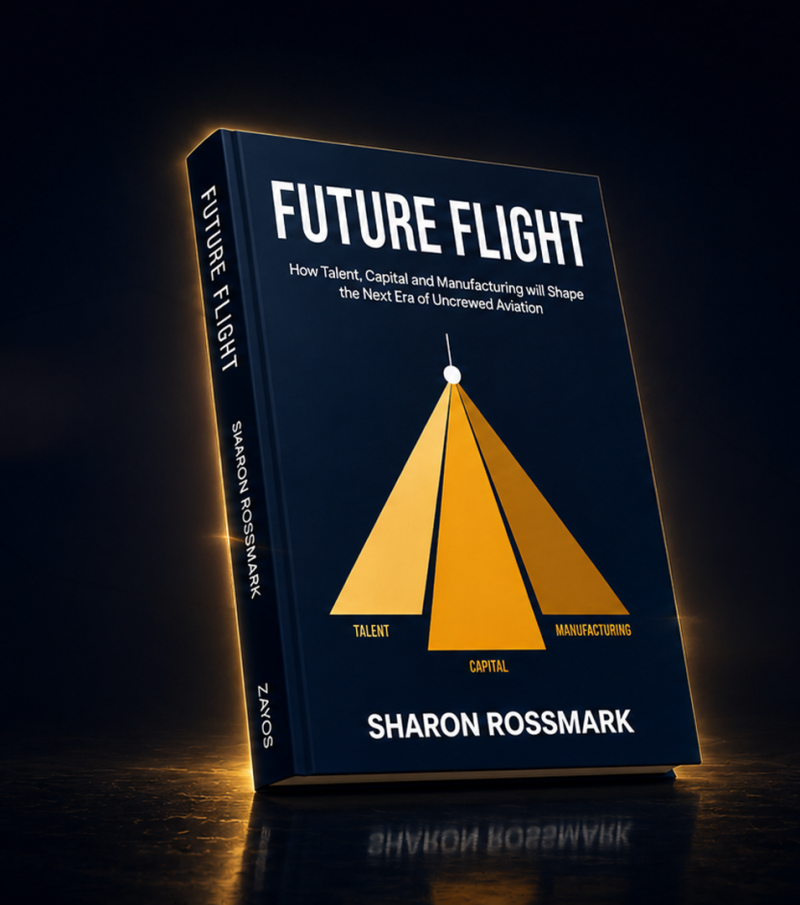
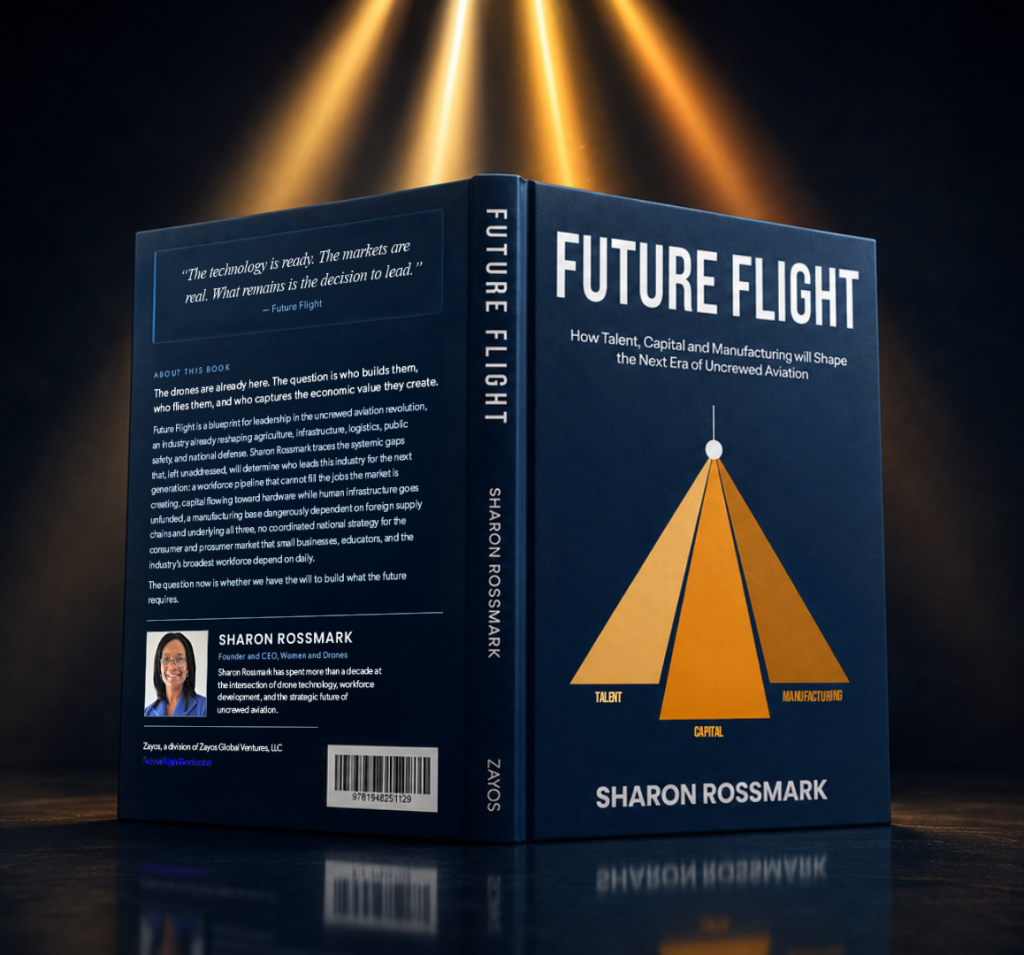
Rossmark’s central claim is straightforward: the future of drone aviation will be determined less by what the aircraft can do and more by whether the country builds the systems around them. She traces that argument through three interlocking gaps:
- A workforce pipeline that cannot yet fill the jobs the market is already creating
- Capital flows that favor hardware while underfunding the human infrastructure required to scale it
- A manufacturing base still dependent on foreign supply chains for critical components
Beneath all three, Rossmark writes, is the absence of a coordinated national strategy — one that small businesses, educators, and the industry’s broadest workforce rely on every day, whether or not policymakers have named it.
It’s a case she makes with unusual directness for a business book. “The technology was never the hard part,” she writes in Chapter 1. “The hard part has always been developing the people, the systems, and the will to deploy it at scale.” That line, she notes in the front matter, is the book’s thesis — stated before the first scene even unfolds.
Inside Future Flight
The book is organized across sixteen chapters in four parts.
- Part I maps the landscape: the scale of the drone revolution, the geopolitical competition over airspace and supply chains, the talent deficit, and the manufacturing imperative.
- Part II turns to workforce strategy — education and credentialing pipelines, the business case for reaching the full breadth of the talent pool, and the employer practices needed to retain it.
- Part III follows the money, from private capital and defense spending to the regional economic development competition now underway across the country.
- Part IV looks ahead to Advanced Air Mobility (AAM), the regulatory architecture the next decade will require — including the FAA’s Part 108 Beyond Visual Line of Sight (BVLOS) rulemaking — and the integrated national strategy Rossmark argues the moment demands.
A Foreword from the Field
The book opens with a Foreword by Dr. Robin R. Murphy, Raytheon Professor Emeritus of Computer Science and Engineering at Texas A&M University, who led the first deployment of small uncrewed aerial systems to a major disaster response at Hurricane Katrina in 2005. Murphy, a leading voice in field robotics and disaster response, frames the persistent gap between what the industry can build and what it has chosen to build as “one of the most consequential unsolved challenges in robotics and autonomous systems” — not a technology problem, but a human systems problem.
Murphy writes that Rossmark is “uniquely qualified” to make that case: not an academic or think-tank analyst, but someone with more than a decade of direct engagement with the operators, educators, investors, and policymakers shaping the commercial drone ecosystem. She also credits Rossmark with a particular skill that runs throughout the book — the ability to connect the right people and translate complex policy and workforce problems into plain language.
That connective instinct traces back to Women and Drones, the organization Rossmark founded to champion broader participation in uncrewed aviation. Much of Part II, on education pipelines, credentialing, and reaching the full depth of the talent pool, draws directly on that work.
Why Now
Future Flight arrives at what Rossmark describes as an inflection point for the industry. Federal attention to uncrewed systems is rising from executive action on domestic drone manufacturing to the FAA’s Part 108 BVLOS rulemaking. Rossmark argues that this attention creates a window, not a guarantee: the country has the technology, the capital, and the talent base to lead. What it does not yet have is the coordinated will to build what that leadership requires.
The book is written for executives building drone and UAS companies, policymakers shaping regulation and industrial policy, educators developing training and credentialing pipelines, investors evaluating the sector, and regional economic development leaders competing for manufacturing and workforce investment. It is also, more simply, for anyone trying to understand where the real constraints on the industry’s growth actually sit.
About the Author
Sharon Rossmark is the Founder and CEO of Women and Drones and has spent more than a decade advising operators, educators, investors, and policymakers across the uncrewed aviation industry. Before becoming a Part 107 remote pilot, she built a career as a senior corporate executive. She is also the co-author of three children’s books introducing young readers to drones and aviation. Future Flight is her first full-length work for a business and policy audience.
Future Flight is available now in hardcover, paperback, and ebook editions. Learn more at FutureFlightBook.com