

Goods and Others for the AAM Strategy and Plan
The US Department of Transportation (DoT) released The Advanced Air Mobility National Strategy: A Bold Policy Vision for 2026-2036 and The Advanced Air Mobility Comprehensive Plan: LIFTing AAM to Maturity in the United States on 17 December 2025. As opposed to the FAA’s July 2023 AAM Implementation Plan, also known as Innovate28, these complementary documents provide both a vision and guide for execution of the future of AAM in the United States. Whereas Innovate28 gave insight to an initial “crawl” phase and focused on the key aspects required for initial implementation of AAM aircraft into the National Air Space of 2028, the AAM Strategy and Comprehensive Plan expand the discussion both in time and scope.
Embracing the complex nature of AAM as a system of systems, the bulk of the strategy looks at six pillars to build the strategy: airspace, infrastructure, security, community planning and engagement, workforce, and automation. A seventh pillar ties all of these together with overarching recommendations. With this structure, the document promises to “expand the U.S. aviation edge created when the Wright Brothers invented the airplane.”
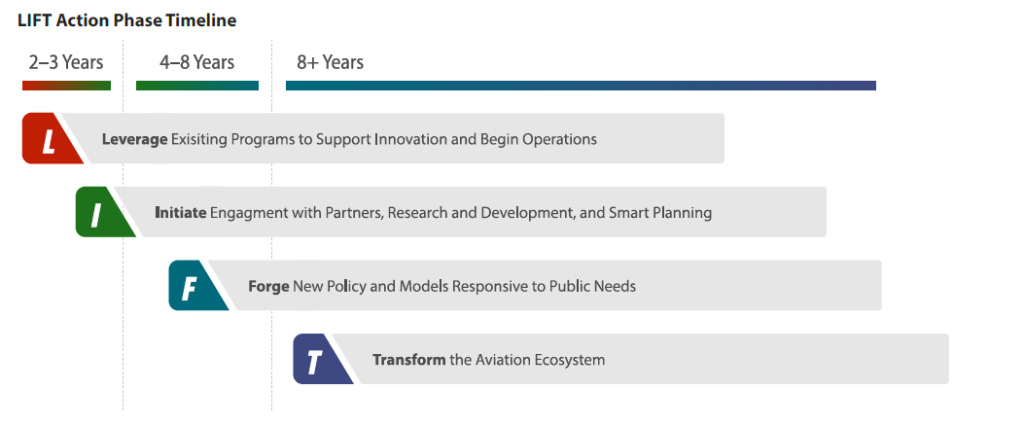
The AAM Comprehensive Plan designates a responsible agency and codifies the necessary actions to accomplish the goals of the strategy for each of the distinct pillars. The plan provides an integrated master schedule for these actions. Using the acronym LIFT–Leverage, Initiate, Forge, Transform–the plan separates actions into four phases with distinct themes. This plan acknowledges both the necessity of overlap in timing for actions as well as possible delays as the uncertainty of the future unfolds. However, the timeline looks realistic with implementation at scale outside of eight years from the adoption of the plan.
The Leverage phase expects to incorporate AAM into existing regulatory and operational frameworks as feasibly as possible, starting in year 1 and continuing through year 2. The Initiate phase focuses on AAM specific research and development activities as well as forward-looking planning last beginning in year three and extending into year 8. This phase is designed to promote a smooth transition from legacy aviation operations to robust AAM operations. Informed by phase two, the Forge phase will begin around year six to develop the regulatory, policy and funding mechanisms to support the buildout of the AAM ecosystem. The fourth and final phase, Transform, is expected to begin a little after eight years, when the US is executing standardized, scaled AM operations. If the strategy and actions begin immediately, optimistic expectations are that AAM will be at scale around 2035.
Created by the AAM Interagency Working Group (IWG) established under the Advanced Air Mobility Coordination and Leadership act of 2022, these documents answer Congress’s direction to the DoT to lead and coordinate the effort of over 100 experts from 25 federal government agencies. Foundational information for the document came from three years of stakeholder engagement including Congress, industry, and State, Local, Tribal and Territorial (SLTT) governments, as well as public open forum meetings and requests for information. There are also areas of the document in which military personnel would debrief as “Goods and Others.”
The document is not only a milestone in the growth of AAM in the United States, but it also serves as a guideline for both federal, SLTT governments and industry of its timely integration. Some of the more impactful and important aspects and shortcomings deserve to be highlighted.
Goods
A close review of the two documents reveals some interesting issues that have not been considered by the general discussions found in social media or other forums. Here are some of those noteworthy aspects. It is worth noting these documents survived a change in administration. Given the considerable shift in many of the policies that occurred when the Trump Administration took office, the continuation and culmination of the IWG’s work underscores the gravity of AAM to the future of the United States. The documents highlight the economic impact as well as the need for the US to maintain leadership in this new aviation era.
Identifying inter-agency cooperation as a critical element to successful implementation of the strategy should be considered a standard across federal efforts. Even a cursory review of the plan shows multiple agencies, and branches of government coordinating various actions. As pointed out in the plan, this collaboration should promote efficiencies in development of technology and improve innovation with cross-pollination of ideas. This aspect should be viewed as a best practice for all major governmental activities.
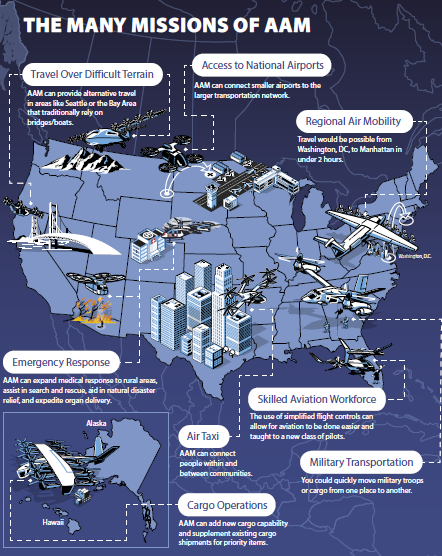
The documents do an excellent job highlighting the benefit to communities and locales under-served by the current aviation industry. Interestingly, the impact of automation and unmanned vehicles are emphasized as deserving the most attention when addressing this issue.
The inclusion of cybersecurity across the strategy and action plan stands out as a strong point. Too often cybersecurity is considered as a secondary concern – particularly when addressed in policy or strategy documents. The AAM communication infrastructure, automation, personal security measures, and many more elements demand this safeguard. Given the scope of operations and the huge effect a breach could have, it is critical to keep cybersecurity front and center.
Introducing Complementary Precision Timing and Navigation throughout these documents aims a spotlight on this issue. Given the vulnerabilities of GPS, it is critical to find a solution to maintaining an aircraft’s three-dimensional location in the event of an outage or nefarious interference. The military has been aware of this issue for years; the incorporation of this issue into the civilian sector is heartening.
While obvious to some, the thought that AAM will be traveling at primarily low altitudes and often around large buildings has escaped the mainstream discussion. This in turn means that the observation and forecasting of weather in this environment has been ignored in large part. The documents rightfully and comprehensively incorporate this vital piece of the puzzle.
The innovation of electrical aviation requires unique skills in engineering, manufacturing, and operations. Identification of new Standard Occupation Codes to recognize and incentivize the discriminating talents within the AAM workforce and support workforce development is foundational to helping this industry grow. Similarly, the push to include AAM related topics in K-12 STEM curriculum provides a foundation for a strong workforce. While support for graduate and post graduate work is important, the foundation of interest in a subject occurs much earlier in a person’s academic life, at the beginning of a person’s career development. Both the emphasis and possible resource allocation to this important aspect of AAM’s future is commendable.
Throughout the document there is reference and recommendation for cooperation research between the military and other agencies. Perhaps this collaboration will be most beneficial in automation and autonomy, as the military has long-invested in the application of autonomy across all domains. The various research and development commands within the services have focused on areas important to their specific missions. Additionally, the Defense Advanced Research Projects Agency (DARPA) has looked at the most difficult aspects of this technology and its application.
The AAM Strategy and its companion plan concentrate cooperation on recommended actions around the research and evaluation of automation. Perhaps most importantly, the FAA’s certification for autonomous vehicles could leverage the operational test and evaluation criteria being implemented for acquisition programs in the US Air Force and Navy. Likewise, investigation and adoption of testing standards for autonomous vehicles should allow all stakeholders more talent and data to ensure safe and robust consideration for new autonomous vehicles.
The AAM community has long pointed out public acceptance as one of the greatest challenges for implementation. The presence of a standalone pillar identifying this aspect gives the document real credibility with the industry. Furthermore, the associated action plan demonstrates the broad scope addressed by the documents. Not only does the strategy and plan look at technological development and tangible challenges, but it also accounts for the soft issues of policy, planning and public involvement that must be tackled to ensure success.
Others
While these documents supply a comprehensive roadmap, there are areas that were either not addressed or lacked detailed discussion. Hopefully, these gaps will be considered as the strategy matures in the future.
The strategy speaks very clearly to the positive economic impact afforded by AAM. However, it is mute on the significant benefit to the environment or energy resource management. The US Energy Information Administration reports on the frequently asked questions page of their website and the global supply of oil will be adequate only up until the year 2050. With the time frame of the AAM strategy stretching beyond 2030, it would be good to add a sense of urgency to meet the looming crisis. Any activity that could reduce the consumption of fossil fuels would push this timeline further to the future and provide more time for maturing technology. Additionally, the reduction in consumption would allow husbanding of strategic oil reserves for the highest priority needs.
While the Department of Energy (DOE) shows up as a critical partner in many of the actions, the document misses an opportunity to drive a greater push for substantial energy policy shifts to support AAM development as well as meet other electrification demands. The document could have been more detailed in its recommended course for item 2.5, “Perform a comprehensive analysis of power capacity and demand that would be led by DOE.” The Comprehensive Plan could have easily included specific recommendations for demonstration of micro grid incorporation and small modular nuclear power development. Instead, it leaves the research and analysis that will occur in Phase 2 to determine a solution. While this course of action allows for additional solution space to be investigated, the implementation of any outcomes for this analysis most likely will take the execution well into the 8+ year timeline for the Transformation phase.
Finally, when identifying a strategy for workforce development, the issues of manpower shortages in critical areas of aircrew remains in the background. In particular, the document should include deployment of automation as a critical aspect in solving this issue. Obviously, uncrewed vehicles alleviate the need for as many pilots, but the ability of a ground controller to monitor and direct multiple vehicles allows for the employment of those that might not have the physical capability to fly a legacy aircraft. Adding these previously unqualified individuals should be included in the strategy.
Conclusion
The United States has taken a significant step forward in adopting AAM as a key aspect of their economy and aviation industry with the publication of the AAM Strategy and accompanying Comprehensive Plan. Addressing the complexity of this endeavor head on, the documents give a good sense of the vision and actions the United States must take to ensure they are not only a part of the action, but a leader in this new evolution of aviation.